
Around menopause, falling oestrogen speeds up bone loss, and that is when Australian calcium recommendations rise. If you do not eat dairy, whether because of intolerance, allergy, a plant-based diet or simple preference, getting enough calcium takes more thought. This guide explains why needs change, which non-dairy foods are richest in calcium, why some plant sources count more than others, and shares a calcium-set tofu stir-fry.
At a glance
- The Australian recommended intake for calcium rises from 1,000 mg to 1,300 mg a day for women over 50.
- Women lose bone more rapidly for about 5 to 10 years around menopause, according to the NHMRC.
- Calcium-set tofu, canned fish with soft bones, almonds, kale and calcium-fortified plant milks are good non-dairy sources.
- Calcium from bok choy and kale is well absorbed. Calcium from spinach is poorly absorbed, so it counts for much less.
- Half of Australian adults do not reach their recommended calcium intake, according to Healthy Bones Australia.
Why calcium needs rise at menopause
Oestrogen helps keep bones strong. As it drops around menopause, bone loss speeds up. The NHMRC notes that for roughly 5 to 10 years around menopause women lose bone more rapidly than men, about 2 to 3% a year, and the Better Health Channel says women can lose up to 10% of their bone density in the first five years after menopause.
The Nutrient Reference Values set the recommended dietary intake for calcium at 1,000 mg a day for women aged 19 to 50 and 1,300 mg a day for women over 50, because after menopause more calcium is lost in urine and absorption probably falls. Healthy Bones Australia and the Australasian Menopause Society use 1,300 mg from age 50. Healthy Bones Australia also reports that half of Australian adults do not reach their recommended intake.
Non-dairy calcium sources
Values are from the Australian Food Composition Database (FSANZ, Release 3), per 100 g unless stated. Eat for Health lists the non-dairy amounts that count as one serve of the dairy food group.
| Food | Calcium (about) | Equal to one dairy serve (Eat for Health) |
|---|---|---|
| Firm tofu | 206 mg per 100 g (varies with how it is set) | 100 g, check the label |
| Canned pink salmon with bones, drained | 191 mg per 100 g | ½ cup (100 g) |
| Canned sardines | not listed in the database | 60 g |
| Almonds with skin | 267 mg per 100 g | 100 g |
| Kale, raw | 215 mg per 100 g | not listed |
| Bok choy, raw | 83 mg per 100 g | not listed |
| Fortified soy drink | 118 mg per 100 mL | 1 cup (250 mL), with at least 100 mg added calcium per 100 mL |
Plant milks are only a dairy alternative if they are fortified. Food standards allow calcium to be added to soy, oat, rice and nut drinks but do not require it, so check the label for at least 100 mg per 100 mL.
Not all plant calcium counts the same
How much calcium your body absorbs matters as much as how much is in the food. In research by Weaver and colleagues, the body absorbed about 54% of the calcium in bok choy and 49% in kale, compared with 32% from milk, but only about 5% from spinach, because spinach is high in oxalate, which binds calcium. That means you would need about 16 servings of spinach to absorb the calcium in a glass of milk, but only about 2 to 3 servings of bok choy. Calcium from calcium-set tofu was absorbed about as well as calcium from milk in a separate study.
The NHMRC also notes calcium absorption from dried beans is about half that of milk. So beans help, but they should not be your only source.
Try this recipe
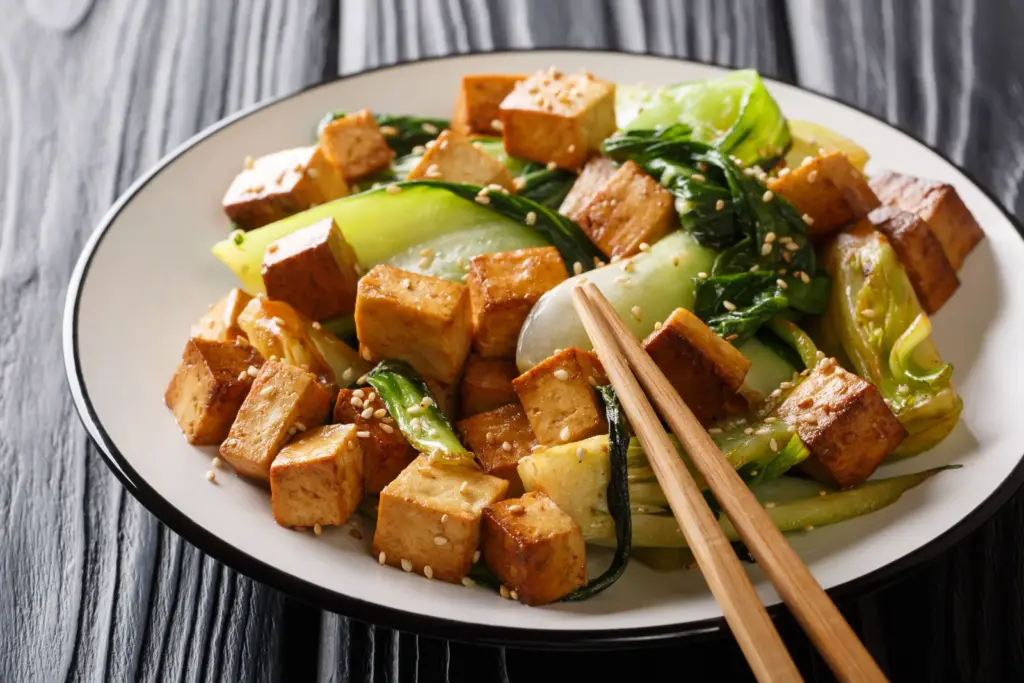
Calcium tofu & bok choy stir-fry
Calcium-set tofu and bok choy are two of the best-absorbed plant sources of calcium, and this stir-fry puts them together in 20 minutes. Check that your tofu label lists a calcium salt such as calcium sulphate or calcium chloride.
You will need:
- 300g firm calcium-set tofu, cubed
- 2 bunches bok choy, chopped
- 1 red capsicum, sliced
- 2 cloves garlic
- 1 tbsp tamari
- 1 tsp sesame oil
- 1 tbsp olive oil
Try it yourself: Add up the calcium in a typical day and compare it with the recommendation for your age. Open the calcium calculator →
Getting the balance right for your bones
How much calcium you need from food, and whether a supplement or vitamin D check is worth discussing with your GP, depends on your age, menopause stage, bone density results, medicines and what you already eat. Felicity can review your intake and help you meet your needs without dairy.
Felicity Bull is an Accredited Practising Dietitian. She sees clients in person in Mount Hutton (Newcastle and Lake Macquarie) and by telehealth across Australia. About menopause nutrition support.
Book with Felicity →Common questions
How much calcium do women need after menopause?
The Australian recommended dietary intake is 1,300 mg a day for women over 50, up from 1,000 mg for women aged 19 to 50.
What foods are high in calcium besides dairy?
Calcium-set tofu, canned salmon or sardines with the bones, almonds, kale, bok choy and calcium-fortified plant milks. Check plant milk labels for at least 100 mg of calcium per 100 mL.
Is the calcium in spinach absorbed?
Very little. Research found only about 5% of the calcium in spinach is absorbed because of its oxalate, compared with about 50% from bok choy and kale.
Are plant milks a good source of calcium?
Only fortified ones. Fortification is allowed but not required in Australia, so check that the label shows at least 100 mg of calcium per 100 mL.
Should I take a calcium supplement in menopause?
Food is the preferred source. Whether a supplement suits you depends on your intake, bone health and medicines, so talk to your GP or dietitian before starting one.
Where this comes from
General information only, not personal advice. It does not replace advice from your doctor or dietitian.
- National Health and Medical Research Council, Nutrient Reference Values for Australia and New Zealand. Calcium. www.eatforhealth.gov.au/nutrient-reference-values/nutrients/calcium
- Healthy Bones Australia. Calcium and bone health. healthybonesaustralia.org.au/your-bone-health/calcium/
- Australasian Menopause Society. Menopause and bone health: decreasing the risk of osteoporosis (fact sheet). hub.menopause.org.au/Play?pId=b982016e-27ba-49ea-9689-051544d45a03
- Better Health Channel (Victorian Government). Menopause and osteoporosis. www.betterhealth.vic.gov.au/health/conditionsandtreatments/menopause-and-osteoporosis
- Jean Hailes for Women’s Health. Bone health. www.jeanhailes.org.au/health-topics/bone-health/
- Eat for Health (NHMRC). Milk, yoghurt, cheese and/or their alternatives, mostly reduced fat. www.eatforhealth.gov.au/food-essentials/five-food-groups/milk-yoghurt-cheese-andor-their-alternatives-mostly-reduced-fat
- Food Standards Australia New Zealand. Australian Food Composition Database, Release 3 (December 2025): nutrient profiles, caffeine (analysed values per 100 g or 100 mL). www.foodstandards.gov.au/science-data/food-nutrient-databases/afcd/data-files
- Weaver CM, Proulx WR, Heaney R. Choices for achieving adequate dietary calcium with a vegetarian diet. American Journal of Clinical Nutrition. 1999;70(3 Suppl):543S-548S. pubmed.ncbi.nlm.nih.gov/10479229/
- Weaver CM, Heaney RP, Connor L, et al. Bioavailability of calcium from tofu as compared with milk in premenopausal women. Journal of Food Science. 2002;67(8):3144-3147. ift.onlinelibrary.wiley.com/doi/abs/10.1111/j.1365-2621.2002.tb08873.x