
Search for an endometriosis diet and you will find long lists of foods to avoid and promises of an “anti-inflammatory” fix. The honest picture is more modest. Around one in seven Australian women born in the 1970s had been diagnosed with endometriosis by their late forties, according to the AIHW, and many want to know whether food can help. This guide explains what the guidelines and research actually say, where anti-inflammatory eating fits, and shares one simple dinner built on the foods with the most interest behind them.
At a glance
- European (ESHRE) guidelines say there is not enough evidence to recommend any specific diet for endometriosis pain.
- Australia’s RANZCOG guideline, updated in 2026, suggests clinicians discuss a low FODMAP diet, fish oil and vitamin D with people with endometriosis, while explaining the evidence of benefit is limited.
- In a large US cohort, women with the highest long-chain omega-3 intake were 22% less likely to be diagnosed with endometriosis. That is an association, not proof of cause.
- A Monash trial found a low FODMAP diet improved gut symptoms in 60% of women with endometriosis, compared with 26% on a control diet.
- Diet is one part of care alongside your gynaecologist or GP, not a replacement for it.
What the guidelines say
The 2022 ESHRE guideline concluded that no recommendation can be made for any specific nutrition intervention to reduce pain or improve quality of life in endometriosis, because the potential benefits and harms are unclear. It noted that, based on a few studies, clinicians may suggest fish oils as an alternative to more harmful anti-inflammatory medicines.
Australia’s living endometriosis guideline from RANZCOG goes slightly further. It suggests that clinicians discuss diet advice (a low FODMAP diet) and dietary supplements (fish oil and vitamin D) with people with endometriosis to manage pain, but that people should be told the evidence of benefit is limited. Jean Hailes says there is no direct evidence that nutrition influences endometriosis, but a healthy diet is important for overall wellbeing.
What “anti-inflammatory” eating means here
Endometriosis involves inflammation, so it makes sense that people look to foods linked with lower inflammation. The best-known study is from the US Nurses’ Health Study II, a large group of nurses followed over many years, in which 1,199 women had endometriosis confirmed by surgery. Those with the highest intake of long-chain omega-3 fats (the kind in oily fish) were 22% less likely to be diagnosed with endometriosis, and those with the highest trans fat intake were 48% more likely. Because this was an observational study of diagnosis, it cannot tell us whether eating more fish reduces symptoms in someone who already has endometriosis.
When fish oil has been tested directly, results have been mixed. A 2020 trial in 69 young people aged 12 to 25 found fish oil did not reduce pain more than a placebo. Systematic reviews of diet and endometriosis pain have found that most studies report some benefit, but that they are small and at moderate or high risk of bias.
In practice, “anti-inflammatory” eating usually means a pattern built on vegetables, fruit, wholegrains, legumes, nuts, seeds, olive oil and oily fish, with fewer highly processed foods. That pattern is in line with the Australian Dietary Guidelines and is good for health in general, even if its effect on endometriosis pain is not proven.
When the gut is the problem
Many people with endometriosis have bloating, pain and bowel symptoms that overlap with irritable bowel syndrome. A 2025 randomised crossover trial from Monash University in 35 women found 60% responded to a low FODMAP diet compared with 26% on a control diet, with improvements in abdominal pain, bloating and quality of life. A low FODMAP diet is meant to be done in stages with a dietitian and is not a long-term way of eating, because cutting out many foods for too long can affect nutrition and gut bacteria.
Try this recipe
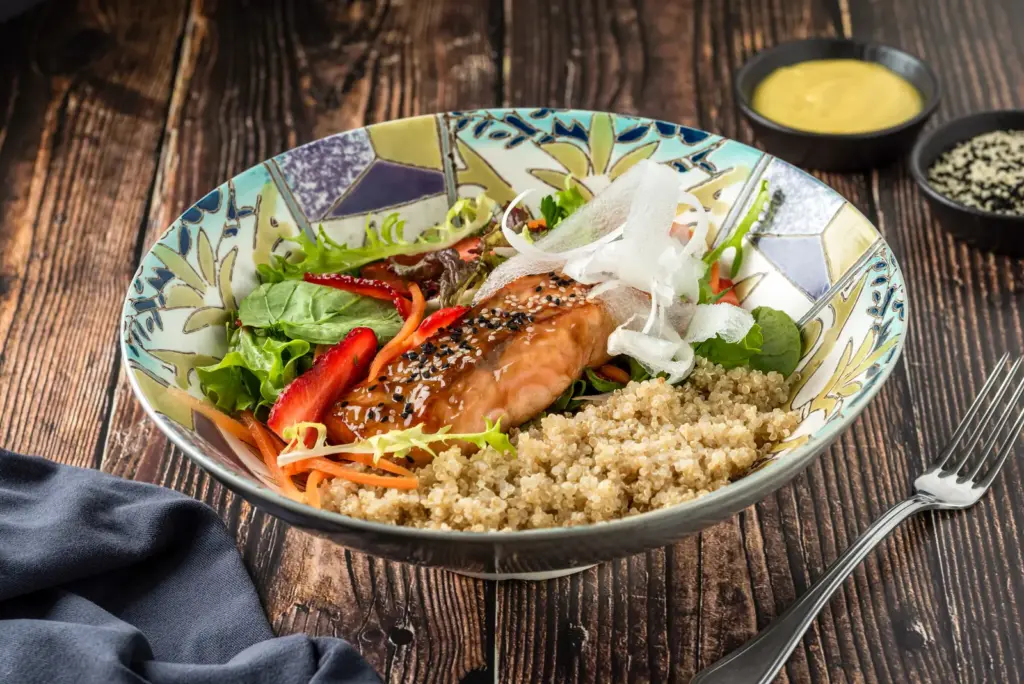
Sesame-crusted salmon with steamed greens
Salmon is one of the richest sources of long-chain omega-3, and the greens and sesame seeds round out a quick weeknight dinner. It is an easy way to include oily fish, which the Heart Foundation suggests eating 2 to 3 times a week as part of a healthy pattern.
You will need:
- 2 salmon fillets
- 2 tbsp sesame seeds
- 1 tbsp tamari (gluten-free soy sauce)
- 1 bunch broccolini
- 1 cup green beans
- 1 tsp sesame oil
Where a dietitian fits in your endometriosis care
What helps depends on your symptoms, especially whether pain, bloating or bowel changes are the main problem, your other treatments, and what you already eat. Felicity can help you sort through the evidence, guide a low FODMAP trial properly if it suits you, and make sure your diet stays nourishing.
Felicity Bull is an Accredited Practising Dietitian. She sees clients in person in Mount Hutton (Newcastle and Lake Macquarie) and by telehealth across Australia. About endometriosis nutrition support.
Book with Felicity →Common questions
Is there a special diet for endometriosis?
No. Guidelines say there is not enough evidence to recommend a specific endometriosis diet. Some people find diet changes help symptoms, especially gut symptoms, and Australian guidelines suggest discussing options with a clinician.
Does an anti-inflammatory diet help endometriosis?
Research is limited. Higher omega-3 intake was linked with a lower chance of diagnosis in a large cohort, but trials of fish oil for pain have been mixed. An eating pattern rich in plants and oily fish is healthy overall.
Can a low FODMAP diet help endometriosis?
It may help gut symptoms. In a 2025 Monash trial, 60% of women with endometriosis responded to a low FODMAP diet compared with 26% on a control diet. It should be done with a dietitian.
Should I take fish oil for endometriosis?
Australian guidelines suggest clinicians discuss it, while noting the evidence of benefit is limited. A trial in young people found no difference from placebo. Talk to your doctor before starting supplements.
What should I eat for dinner with endometriosis?
A balanced dinner with vegetables, wholegrains or legumes, and a protein such as oily fish is a good base. If you have gut symptoms, a dietitian can help you work out which foods are triggers.
Where this comes from
General information only, not personal advice. It does not replace advice from your doctor or dietitian.
- Australian Institute of Health and Welfare. Endometriosis in Australia (Cat. no. PHE 329). www.aihw.gov.au/reports/chronic-disease/endometriosis-in-australia/contents/about
- ESHRE Endometriosis Guideline Development Group. Endometriosis: guideline of the European Society of Human Reproduction and Embryology. 2022 (diet, pages 77-78). www.eshre.eu/-/media/sitecore-files/Guidelines/Endometriosis/ESHRE-GUIDELINE-ENDOMETRIOSIS-2022_1.pdf
- RANZCOG. Australian Living Evidence Guideline: Endometriosis (recommendation 55, updated March 2026). ranzcog.edu.au/wp-content/uploads/Endometriosis-Clinical-Practice-Guideline.pdf
- Jean Hailes for Women’s Health. Endometriosis: management and treatment. www.jeanhailes.org.au/health-a-z/endometriosis/management-treatment
- Missmer SA, Chavarro JE, Malspeis S, et al. A prospective study of dietary fat consumption and endometriosis risk. Human Reproduction. 2010;25(6):1528-1535. europepmc.org/article/MED/20332166
- Nodler JL, DiVasta AD, Vitonis AF, et al. Supplementation with vitamin D or omega-3 fatty acids in adolescent girls and young women with endometriosis (SAGE): a double-blind, randomized, placebo-controlled trial. American Journal of Clinical Nutrition. 2020. europepmc.org/article/MED/32453393
- Nirgianakis K, Egger K, Kalaitzopoulos DR, et al. Effectiveness of dietary interventions in the treatment of endometriosis: a systematic review. Reproductive Sciences. 2022;29:26-42. europepmc.org/article/MED/33761124
- Sverrisdottir UA, Hansen S, Rudnicki M. Impact of diet on pain perception in women with endometriosis: a systematic review. European Journal of Obstetrics and Gynecology and Reproductive Biology. 2022. europepmc.org/article/MED/35245715
- Varney JE, So D, Gibson PR, et al. Low FODMAP diet for gut symptoms in endometriosis: a randomised crossover trial. Alimentary Pharmacology and Therapeutics. 2025. europepmc.org/article/MED/40319391
- Heart Foundation Australia. Omega-3 and omega-6 and heart health. www.heartfoundation.org.au/healthy-living/healthy-eating/omega-3-omega-6-heart-health