Add as a preferred source on Google
Seed cycling means eating flax and pumpkin seeds in the first half of your menstrual cycle, then sesame and sunflower seeds in the second half, to “balance hormones”. Does it work? There are only a handful of studies of seed cycling itself. They are small, mostly uncontrolled, and their hormone results point in different directions. The seeds are a nutritious food, so eating them is fine, but there is no good evidence that the timing matters.
Does seed cycling work? There is no good evidence that seed cycling balances hormones. The few studies of seed cycling itself are small, mostly uncontrolled and point in different directions. The seeds are still nutritious foods, so eating them is fine; expecting them to change your cycle is not supported by the research.
At a glance
- Seed cycling: 1 tablespoon each of ground flax and pumpkin seeds from day 1 of your period to ovulation, then sesame and sunflower seeds until your next period.
- A PubMed search finds just four human reports of the full four-seed routine: one non-randomised PMOS (formerly PCOS) study, a case report, a review and an industry-funded trial with no control group.
- No study has compared eating the seeds in phases with eating the same seeds every day.
- Flaxseed on its own has better trials. In PMOS it was linked with some metabolic and hormone changes. In menopause, blinded trials found it did not reduce hot flushes more than placebo.
- The seeds give you fibre, zinc, vitamin E and plant omega-3. You can eat them on any day of the month.
- If your periods are irregular, painful or missing, see your GP rather than relying on seeds.
What is seed cycling?
Seed cycling splits the menstrual cycle into two halves and assigns two seeds to each. Most guides suggest about a tablespoon of each seed a day, usually ground.
| Phase | When | Seeds | What proponents say they do |
|---|---|---|---|
| Follicular | Day 1 of your period until ovulation | Ground flaxseed and pumpkin seeds | Lignans and zinc are said to support oestrogen in the first half of the cycle |
| Luteal | Ovulation until your next period | Sesame and sunflower seeds | Zinc, selenium and vitamin E are said to support progesterone in the second half |
The right-hand column is the claim, not established fact. Many guides use a fixed 28-day calendar, and some suggest the same routine after menopause. Real cycles vary: Jean Hailes says an adult cycle is usually 21 to 35 days, with ovulation about 2 weeks before the next period. That makes it hard to know when to switch, especially if your periods are irregular.
The mechanisms people cite
The idea draws on real nutrition science, stretched further than the evidence goes.
- Lignans. Flaxseed is by far the richest food source of plant lignans, and sesame is a much smaller one. Gut bacteria turn lignans into compounds called enterolignans, which have weak oestrogen-like activity. How much this affects hormones in people is not well understood.
- Zinc, selenium and vitamin E. The seeds supply them in different amounts: pumpkin and sesame for zinc, sunflower for vitamin E and selenium. They matter for general health, but we found no study showing that eating them in one half of the cycle changes progesterone.
- Omega-3. Flaxseed is rich in alpha-linolenic acid (ALA), a plant omega-3. The other three seeds contain very little.
Even if a seed did affect hormones, nothing in this research explains why it would only help on certain days of the month.
Does seed cycling work? What the studies show
We searched PubMed for “seed cycling” in October 2026. Only four records report the full four-seed routine in people. A 2025 systematic review also included two more studies that are not indexed there. Here is everything we could find.
| Study | Who | Design | What it found |
|---|---|---|---|
| Rasheed 2023, Pakistan | Women with PMOS | 90 women recruited, groups of 20 reported, no randomisation described; the seed group also got a portion-controlled diet | Small falls in FSH (1.2 to 2.5%) and LH (1.5 to 2%) with diet plus seeds |
| Ajith 2024 and Kour 2024, India (summarised in a 2025 review) | 30 and 290 women with PMOS | Interventional and cohort designs | More regular cycles reported in one; in the other, FSH and LH rose, the opposite direction to Rasheed |
| Dhamija 2025, India | One woman with PMOS | Case report; she also took myo-inositol and folic acid, then had IVF | Regular cycles and a pregnancy, but it is impossible to say what caused what |
| O’Gorman 2026, USA | 40 women with premenstrual symptoms | Single group, no control, funded by the capsule maker; capsules also had psyllium and chasteberry | Symptom scores improved; the authors say randomised trials are needed |
The 2025 systematic review pooled 10 studies (635 women) on seed cycling or single seeds in PMOS and premenstrual syndrome. It called seed cycling a “potentially effective” add-on, but said its conclusion rests on “small sample sizes and moderate-quality evidence” and that larger randomised trials are needed. Only four of its 10 studies tested the full routine, and one of those was a single person.
The biggest gap: no study has compared seeds eaten in phases with the same seeds eaten every day, or with no seeds and the same diet changes. Without that, any benefit could come from the extra fibre and nutrients, from other diet changes, or from people simply expecting to feel better.
What flaxseed studies show
Flaxseed has been studied more than seed cycling, so it is worth looking at separately.
- Menstrual cycle (1993). In a crossover study of 18 women with regular cycles, adding flaxseed to the usual diet for three cycles was linked with fewer cycles without ovulation (none in 36 flax cycles versus 3 in 36 usual cycles) and a slightly longer luteal phase (12.6 versus 11.4 days). Oestrogen and progesterone levels did not change, though the ratio between them did. This study is often quoted for seed cycling, but the women ate flax every day of the cycle, not only in the first half.
- PMOS. Two small Iranian trials gave 30 g of flaxseed a day plus lifestyle advice, compared with lifestyle advice alone, for 12 weeks. One (41 women) found lower insulin, insulin resistance, triglycerides and inflammation markers. The other (70 women) found a small rise in FSH and a lower LH to FSH ratio, with no change in the androgens it measured (DHEAS and androstenedione). Neither was blinded.
- Menopause. Two blinded trials found flaxseed no better than placebo for hot flushes: a muffin trial in 99 women over 16 weeks, and a 188-woman trial of flaxseed bars. A Cochrane review of 43 trials of plant oestrogens found no conclusive evidence that they reduce hot flushes or night sweats, and noted a strong placebo effect.
So flaxseed may have some metabolic benefits in PMOS, as part of an overall eating pattern. That is a reason to enjoy it, not a reason to time it.
Seed cycling for PMOS (PCOS)
The 2023 International Evidence-based PCOS Guideline found no evidence that any one type of diet is better than another for hormonal, reproductive or metabolic outcomes. It recommends healthy eating tailored to your preferences, and warns against diets that are unduly restrictive or unbalanced. It also says a healthy lifestyle has benefits even without weight loss. Seed cycling is not mentioned in the guideline. If you have PMOS, our PMOS (PCOS) diet guide covers the eating patterns with the most evidence, and insulin resistance explained covers why fibre-rich meals help.
Seed cycling for menopause
After menopause there are no cycle phases left to follow, so seed cycling guides often switch to a calendar. The main seed with menopause trials is flaxseed, and those trials did not show it eases hot flushes more than placebo. For support with hot flushes, sleep and bone health, see our menopause and perimenopause nutrition page or try the perimenopause nutrition checker.
What the four seeds give you
Here is how the seeds compare. Values are per 100 g from USDA FoodData Central. A daily spoonful is much less than 100 g, so treat this as a comparison between seeds, not a daily dose.
| Per 100 g | Flaxseed | Pumpkin seeds | Sesame seeds (whole) | Sunflower seeds |
|---|---|---|---|---|
| Fibre | 27.3 g | 6.0 g | 11.8 g | 8.6 g |
| Plant omega-3 (ALA) | 22.8 g | 0.1 g | 0.4 g | 0.1 g |
| Zinc | 4.3 mg | 7.8 mg | 7.8 mg | 5.0 mg |
| Iron | 5.7 mg | 8.8 mg | 14.6 mg | 5.3 mg |
| Vitamin E | 0.3 mg | 2.2 mg | 0.3 mg | 35.2 mg |
| Selenium | 25 micrograms | 9 micrograms | 34 micrograms | 53 micrograms |
Each seed brings something different: flax for fibre and omega-3, pumpkin and sesame for zinc and iron, sunflower for vitamin E and selenium. That is a good argument for a mix of seeds across the week, in whatever order suits you. If you have heavy periods, read why women need more iron.
Try it yourself: See roughly how much fibre you eat in a day and where seeds, grains, fruit and legumes fit. Open the fibre calculator →
Is seed cycling safe?
For most people, eating seeds as food is safe. A few things are worth knowing:
- Sesame allergy. Sesame is one of the allergens that must be declared on Australian food labels. Skip it if you are allergic.
- Raw flaxseed. Do not eat raw or unripe flaxseed, which may contain toxic compounds.
- Gut symptoms. Larger amounts of flaxseed can cause bloating, fullness and diarrhoea. Start with a small amount.
- Medicines. There are theoretical reasons flaxseed might interact with blood-thinning medicines. If you take regular medicines, including any you have been prescribed for PMOS, ask your pharmacist or GP before adding large amounts of flaxseed or seed capsules.
- Hormone-sensitive breast cancer. Memorial Sloan Kettering advises people with oestrogen receptor positive breast cancer to talk to their doctor before using flaxseed products.
The bigger risk is often not the seeds, but what you might delay. Seed cycling should not stand in for checking why periods are missing, very painful or irregular.
When food rules start to feel rigid
For some people, a routine like seed cycling becomes another set of rules: the right food on the right day, and guilt when a day is missed. Researchers describe orthorexia as an obsessive preoccupation with healthy eating. It is not a formal diagnosis, but the distress is real. If tracking your cycle and your food is starting to feel stressful, or you have a history of an eating disorder, you are better off without the rules. Our eating disorder dietitian page explains how we help.
Better-evidenced ways to support your cycle
- Eat regularly and enough. Healthdirect lists sudden weight changes and stress among the lifestyle causes of irregular periods, so steady, adequate eating matters more than any single food.
- Choose fibre-rich foods. Wholegrains, legumes, vegetables, fruit, nuts and seeds. Seeds count, on any day.
- Look after iron. If your periods are heavy, check your iron intake. Our iron intake calculator gives a rough check.
- Get the cause checked. PMOS and adenomyosis can change your periods, and endometriosis can make them very painful. Each has its own care plan. See PMOS (PCOS) symptoms and nutrition for endometriosis.
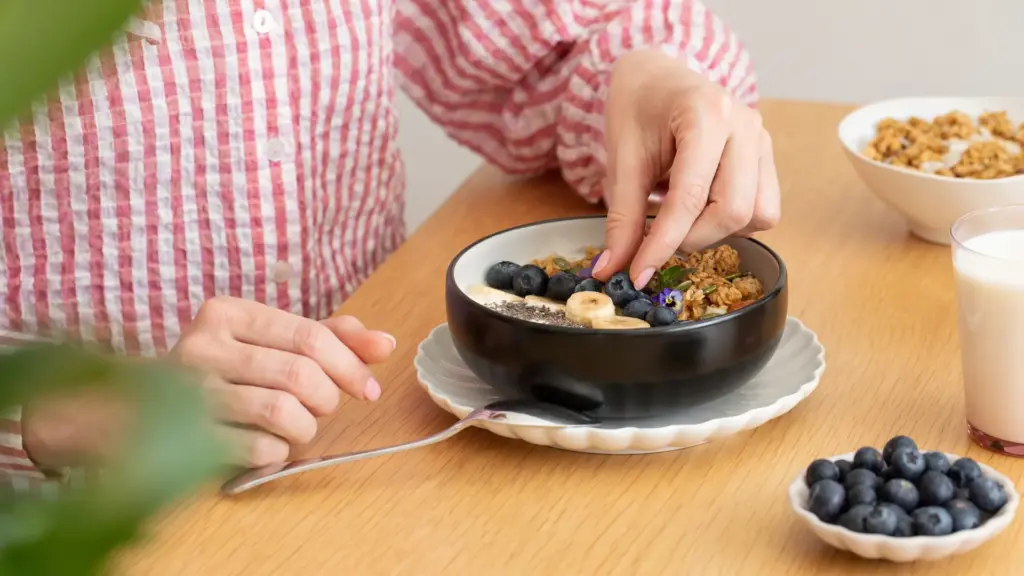
Easy ways to eat the seeds: stir ground flax into porridge or yoghurt, sprinkle pumpkin or sunflower seeds over salads, add sesame to stir-fries, or keep a jar of mixed seeds on the bench.
When to see your GP
Healthdirect advises seeing a doctor if you have not had a period for 3 months or more, have 8 or fewer periods a year, have periods lasting longer than 7 days, bleed between periods or after sex, or have irregular periods and trouble falling pregnant. Severe period pain, very heavy bleeding or signs of low iron, such as ongoing tiredness, are also worth checking. Your GP can look for causes such as PMOS or low iron.
Want a plan that fits your cycle?
What helps your periods depends on the cause: PMOS, endometriosis, low iron, under-eating or something else, plus your medicines, food preferences and history with food. Felicity can look at the whole picture and build an eating plan around what the evidence supports for you, without rigid rules.
Felicity Bull is an Accredited Practising Dietitian. She sees clients in person in Mount Hutton (Newcastle and Lake Macquarie) and by telehealth across Australia. About our women’s health nutrition support.
Book with Felicity →Common questions
Does seed cycling work?
There is no good evidence that it does. Only a few small studies have tested it, most without a proper control group, and none compared eating the seeds in phases with eating them every day.
What seeds do you eat in each phase of seed cycling?
Ground flaxseed and pumpkin seeds from day 1 of your period until ovulation, then sesame and sunflower seeds from ovulation until your next period, usually about a tablespoon of each.
Can seed cycling help PMOS (PCOS)?
It has not been shown to. The 2023 international PCOS guideline found no evidence that any one diet type is better than another. Flaxseed alone has shown some metabolic benefits in small PMOS (PCOS) trials.
Does seed cycling help with menopause?
There is no evidence that it does. Blinded trials found flaxseed no better than placebo for hot flushes, and a Cochrane review found no conclusive benefit from plant oestrogens.
Is seed cycling safe?
Eating seeds is safe for most people. Avoid sesame if you are allergic, do not eat raw flaxseed, and check with your pharmacist or GP if you take regular medicines or have hormone-sensitive breast cancer.
Are the seeds still worth eating?
Yes. Flax, pumpkin, sesame and sunflower seeds provide fibre, zinc, iron, vitamin E, selenium and, in flax, plant omega-3. You can eat them on any day of your cycle.
Where this comes from
General information only, not personal advice. It does not replace advice from your doctor or dietitian.
- Jean Hailes for Women’s Health. Periods. www.jeanhailes.org.au/health-topics/periods/
- Drake VJ. Lignans. Micronutrient Information Center, Linus Pauling Institute, Oregon State University (updated March 2021). lpi.oregonstate.edu/mic/dietary-factors/phytochemicals/lignans
- Rasheed N, Ahmed A, Nosheen F, et al. Effectiveness of combined seeds (pumpkin, sunflower, sesame, flaxseed): as adjacent therapy to treat polycystic ovary syndrome in females. Food Science and Nutrition. 2023;11(6):3385-3393. pubmed.ncbi.nlm.nih.gov/37324929/
- Nagarajan DR, Mani Jacob D, Munir Mufti M, Rajesh S, Dube R. Efficacy of seed cycling as an integrative therapy for premenstrual syndrome and polycystic ovary syndrome in reproductive-aged women: a systematic review. Cureus. 2025;17(8):e90997. pubmed.ncbi.nlm.nih.gov/41018334/
- Dhamija P, More A, Choudhary N, et al. Seed cycling and hormonal balance: a case study of successful fertility intervention in polycystic ovarian syndrome. Journal of Pharmacy and Bioallied Sciences. 2025;17(Suppl 1):S1030-S1033. pubmed.ncbi.nlm.nih.gov/40511049/
- O’Gorman E, Kaunzner UW, Mitschke S. Symptoms of premenstrual syndrome in women receiving seed cycling capsules with chasteberry: a single-arm clinical trial over two cycles. Cureus. 2026;18(8):e115036. pubmed.ncbi.nlm.nih.gov/42639569/
- Phipps WR, Martini MC, Lampe JW, Slavin JL, Kurzer MS. Effect of flax seed ingestion on the menstrual cycle. Journal of Clinical Endocrinology and Metabolism. 1993;77(5):1215-1219. pubmed.ncbi.nlm.nih.gov/8077314/
- Haidari F, Banaei-Jahromi N, Zakerkish M, Ahmadi K. The effects of flaxseed supplementation on metabolic status in women with polycystic ovary syndrome: a randomized open-labeled controlled clinical trial. Nutrition Journal. 2020;19(1):8. pubmed.ncbi.nlm.nih.gov/31980022/
- Najdgholami Z, Sedgi FM, Ghalishourani SS, Feyzpour M, Rahimlou M. Flaxseed intervention and reproductive endocrine profiles in patients with polycystic ovary syndrome: an open-labeled randomized controlled clinical trial. Frontiers in Endocrinology. 2025;16:1531762. pubmed.ncbi.nlm.nih.gov/40260281/
- Lewis JE, Nickell LA, Thompson LU, et al. A randomized controlled trial of the effect of dietary soy and flaxseed muffins on quality of life and hot flashes during menopause. Menopause. 2006;13(4):631-642. pubmed.ncbi.nlm.nih.gov/16837885/
- Pruthi S, Qin R, Terstreip SA, et al. A phase III, randomized, placebo-controlled, double-blind trial of flaxseed for the treatment of hot flashes: North Central Cancer Treatment Group N08C7. Menopause. 2012;19(1):48-53. pubmed.ncbi.nlm.nih.gov/21900849/
- Lethaby A, Marjoribanks J, Kronenberg F, et al. Phytoestrogens for menopausal vasomotor symptoms. Cochrane Database of Systematic Reviews. 2013;(12):CD001395. pubmed.ncbi.nlm.nih.gov/24323914/
- Teede HJ, Tay CT, Laven J, et al. Recommendations from the 2023 International Evidence-based Guideline for the Assessment and Management of Polycystic Ovary Syndrome. Human Reproduction. 2023;38(9):1655-1679. pmc.ncbi.nlm.nih.gov/articles/PMC10477934/
- US Department of Agriculture. FoodData Central, SR Legacy: Seeds, flaxseed (FDC ID 169414). fdc.nal.usda.gov/food-details/169414/nutrients
- US Department of Agriculture. FoodData Central, SR Legacy: Seeds, pumpkin and squash seed kernels, dried (FDC ID 170556). fdc.nal.usda.gov/food-details/170556/nutrients
- US Department of Agriculture. FoodData Central, SR Legacy: Seeds, sesame seeds, whole, dried (FDC ID 170150). fdc.nal.usda.gov/food-details/170150/nutrients
- US Department of Agriculture. FoodData Central, SR Legacy: Seeds, sunflower seed kernels, dried (FDC ID 170562). fdc.nal.usda.gov/food-details/170562/nutrients
- Food Standards Australia New Zealand. Food allergies. www.foodstandards.gov.au/consumer/foodallergies
- National Center for Complementary and Integrative Health. Flaxseed and flaxseed oil (updated February 2025). www.nccih.nih.gov/health/flaxseed-and-flaxseed-oil
- Memorial Sloan Kettering Cancer Center. Flaxseed. About Herbs (updated July 2026). www.mskcc.org/cancer-care/integrative-medicine/herbs/flaxseed
- Horovitz O, Argyrides M. Orthorexia and orthorexia nervosa: a comprehensive examination of prevalence, risk factors, diagnosis, and treatment. Nutrients. 2023;15(17):3851. pubmed.ncbi.nlm.nih.gov/37686883/
- Healthdirect Australia. Irregular periods (last reviewed March 2026). www.healthdirect.gov.au/symptoms/irregular-periods