Pregnancy Food Safety in Australia: What to Avoid and What You Can Eat
One dodgy chicken sandwich can ruin anyone’s day. During pregnancy, that same sandwich can carry a higher food safety risk for you and your baby.
Food safety in pregnancy is about more than a long list of banned foods. Pregnancy involves changes to your immune system, which can make some foodborne infections more concerning. When you understand which foods are higher risk and how to handle food safely, you can make confident choices without becoming afraid of food.
In this guide for Australian mums-to-be, we explain the main food poisoning risks in pregnancy, what foods to avoid or take extra care with, safer alternatives, and simple ways to cook, store and prepare food.
Most importantly, you do not need to fear food during pregnancy. Adequate nutrition matters too. The goal is to reduce avoidable food safety risks while still eating enough, enjoying a varied diet and meeting your nutritional needs.
Food poisoning risks in pregnancy: Listeria, Salmonella and Toxoplasma
Pregnancy involves changes to immune function. These changes are a normal part of pregnancy, but they can make some infections more concerning.
Three foodborne infections that deserve particular attention are listeriosis, salmonellosis and toxoplasmosis.
Listeria
Listeria monocytogenes is a bacterium that can cause listeriosis.
Listeriosis is rare in Australia, but it can be particularly serious during pregnancy. The infection can affect the placenta, unborn baby or newborn and can lead to serious complications, including miscarriage, stillbirth, premature birth or infection in the newborn.
One of the difficult things about listeriosis is that the pregnant person may not feel very sick. Symptoms can be absent or very mild and may look like an ordinary viral illness.
Possible symptoms include:
-
fever
-
tiredness
-
headache
-
muscle aches
-
nausea
-
vomiting
-
diarrhoea
This means that feeling well does not necessarily rule out listeriosis.
Symptoms also do not always appear immediately after eating contaminated food. Pregnancy, Birth and Baby states that symptoms usually take about three weeks to develop but can occur anywhere from 7 to 70 days after exposure.
This long delay is one reason food safety matters even when you feel completely well after eating.
Listeria can grow at refrigeration temperatures, which is one reason Australian pregnancy guidance places particular emphasis on freshly prepared foods and limiting the storage time of refrigerated ready-to-eat foods.
Listeriosis is uncommon, but the consequences can be serious. That is why Australian pregnancy guidance takes a cautious approach to foods that are more likely to carry Listeria.
Salmonella
Salmonella can cause food poisoning, commonly resulting in diarrhoea, vomiting, abdominal cramps and fever.
Raw or lightly cooked eggs and undercooked meat and poultry can be sources of Salmonella. Good hand hygiene, preventing cross-contamination and thoroughly cooking food are important ways to reduce the risk.
Pregnancy does not mean you need to avoid eggs or chicken altogether. Instead, choose properly cooked versions and follow current Australian food safety advice.
Toxoplasma gondii
Toxoplasma gondii is a parasite that can cause toxoplasmosis. Infection during pregnancy can affect the developing baby, including the brain and eyes.
Toxoplasma can be associated with undercooked meat, contaminated soil and unwashed fruit and vegetables. Contact with cat faeces can also be a source of exposure.
The practical approach is simple: cook meat thoroughly, wash fruit and vegetables carefully, wash your hands after handling raw meat or soil, and take appropriate precautions when handling cat litter.
Foods to avoid in pregnancy: the red-light foods
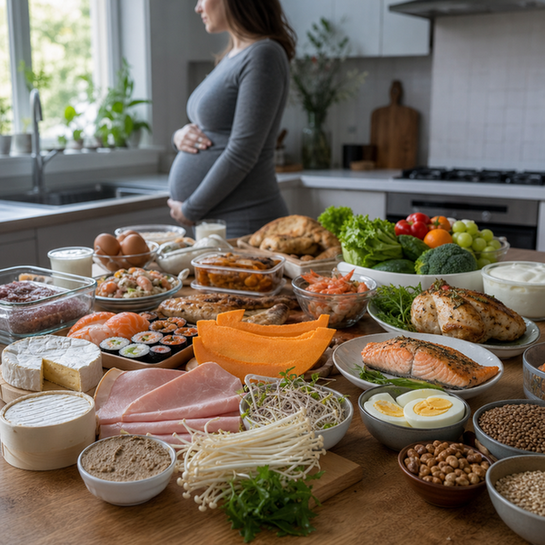
The easiest way to understand pregnancy food safety is to think in traffic lights.
Red means higher risk: avoid these foods during pregnancy unless the relevant Australian guidance says they can be made safer through thorough cooking or another preparation method.
Amber means take extra care: the food may be suitable depending on how it has been prepared, cooked, stored or handled.
Green means lower risk: these foods can generally be enjoyed when they are handled and stored appropriately.
This traffic-light approach is a simplified way to explain Australian food-safety advice. Always follow the specific preparation, cooking and storage instructions for the individual food.
Soft and semi-soft cheeses
Some soft and semi-soft cheeses have a higher risk of Listeria contamination.
Examples include brie, camembert, ricotta, feta and some blue cheeses.
During pregnancy, NSW Food Authority recommends avoiding these cheeses unless they are thoroughly cooked to at least 75°C and eaten soon afterwards.
Hard cheeses such as cheddar and parmesan are lower-risk choices.
Pasteurisation is helpful, but pasteurisation alone does not automatically make every ready-to-eat food low risk. Storage and handling still matter.
If you are unsure about a particular cheese, check current Australian pregnancy guidance or ask your healthcare professional.
Cold deli meats and processed meats
Cold ham, salami, prosciutto, luncheon meats and cold cooked chicken can carry a Listeria risk.
NSW Food Authority recommends avoiding these foods during pregnancy unless they are thoroughly cooked to at least 75°C and eaten soon afterwards.
Heating until thoroughly hot can reduce the risk from bacteria such as Listeria.
Freshly cooked meat is generally a safer choice than refrigerated ready-to-eat deli meat.
Pâté and meat spreads
Refrigerated pâté and meat spreads are higher-risk foods during pregnancy and are best avoided.
Pre-prepared salads and sandwiches
Pre-prepared salads, packaged salads, salad-bar foods and ready-to-eat sandwiches can carry a Listeria risk because they may be handled during preparation and stored for some time before eating.
Freshly prepared salads made at home are generally a lower-risk option when ingredients are washed thoroughly and the salad is prepared and stored safely.
Pre-cut fruit can also present a higher risk because it is ready to eat and may have been handled and stored before purchase.
Raw or lightly cooked eggs
Raw or lightly cooked eggs can carry Salmonella.
During pregnancy, avoid foods containing raw or lightly cooked egg unless the product has been commercially prepared using appropriate food-safety controls.
Foods that may contain raw egg include homemade aioli, some desserts, mousse, cake batter and pancake batter.
Commercially produced mayonnaise and similar products can be suitable when they have been commercially prepared and stored according to the manufacturer’s instructions.
Check the product label and storage instructions rather than assuming every mayonnaise or aioli product is the same.
For eggs cooked at home, avoid cracked or dirty eggs and cook egg dishes thoroughly.
Raw seafood
Raw seafood, including sushi containing raw seafood and sashimi, is best avoided during pregnancy.
Chilled ready-to-eat seafood can also carry a Listeria risk. This includes some smoked seafood and ready-to-eat chilled peeled prawns.
You do not need to avoid seafood altogether. Properly cooked seafood can be an excellent source of protein and omega-3 fatty acids.
Raw sprouts
Raw or lightly cooked sprouts can carry foodborne bacteria and are best avoided during pregnancy.
This includes sprouts such as:
-
alfalfa
-
mung bean
-
soybean
-
broccoli
-
onion
-
sunflower
-
clover
-
radish
-
snow pea
If sprouts are thoroughly cooked, the risk can be reduced.
Enoki mushrooms
Fresh enoki mushrooms can contain Listeria.
During pregnancy, avoid eating enoki mushrooms raw or lightly cooked. If you eat enoki mushrooms, cook them thoroughly.
Soft-serve ice cream
Soft-serve ice cream is another food that Australian pregnancy guidance treats cautiously because the machines can become contaminated if they are not cleaned and sanitised properly.
This does not mean every soft-serve machine is contaminated. It means the cleaning and maintenance of the equipment can be difficult for consumers to assess, so avoiding soft serve during pregnancy is the more cautious choice.
Packaged frozen ice cream that has been kept frozen according to the manufacturer’s instructions is a lower-risk alternative.
Rockmelon
Rockmelon has previously been associated with foodborne illness outbreaks in Australia, including a significant Listeria outbreak.
This does not mean that fresh fruit should be feared.
NSW Food Authority currently advises vulnerable people, including pregnant women, to avoid rockmelon because bacteria can become trapped in the rough rind and may be transferred to the flesh during cutting.
Other fresh foods can also occasionally be involved in outbreaks or product recalls.
The important lesson is not that fresh food is inherently dangerous. It is that food safety problems can occur unexpectedly, which is why recalls and public health alerts exist.
Hummus, tahini and sesame pastes
Current NSW pregnancy guidance recommends avoiding hummus, tahini and other sesame pastes during pregnancy because of their increased risk of Listeria and Salmonella contamination.
If you are unsure about a particular product, check current Australian pregnancy food-safety guidance.
Unpasteurised dairy products
Avoid unpasteurised or raw milk and dairy products during pregnancy.
Raw milk can carry harmful bacteria and other pathogens.
Pasteurised milk, yoghurt, cream and other appropriately handled pasteurised dairy products can form part of a healthy pregnancy diet.
Fermented drinks
Some fermented drinks, including kombucha, kvass, kefir and ginger beer, can contain residual alcohol as a result of fermentation.
Pregnancy guidance therefore recommends caution with these products.
If you are unsure about the alcohol content or safety of a fermented drink, choose a clearly labelled non-alcoholic alternative.
What you can eat in pregnancy: the green-light foods
Pregnancy food safety should never become a reason to unnecessarily restrict your diet.
There are plenty of foods you can continue to enjoy.
Dairy foods
Lower-risk choices include hard cheeses such as cheddar and parmesan, as well as appropriately handled pasteurised dairy products.
Milk and yoghurt are nutritious sources of protein, calcium and other nutrients.
Some higher-risk soft cheeses can also be made safer through thorough cooking. For example, a soft cheese used in a cooked meal may be appropriate when it is heated thoroughly to at least 75°C and eaten soon afterwards.
Meat and poultry
You can continue eating beef, lamb, chicken, pork and mince during pregnancy.
The important points are to cook meat thoroughly and prevent cross-contamination between raw and ready-to-eat foods.
NSW Food Authority recommends cooking meat such as beef, pork, chicken and mince thoroughly to at least 71°C.
For poultry specifically, NSW guidance recommends an internal temperature of at least 74°C.
Use a food thermometer where useful, particularly for poultry, mince and other foods where colour alone may not reliably indicate whether the food is cooked safely.
Eggs
Eggs are an excellent source of protein and several important nutrients.
During pregnancy, cook egg dishes thoroughly. NSW Food Authority recommends cooking egg dishes to at least 71°C.
Hard-boiled eggs, fully cooked omelettes and well-scrambled eggs are simple options.
Avoid raw egg mixtures such as cake batter or homemade mayonnaise containing raw egg.
Seafood
You do not need to give up seafood during pregnancy.
Australian dietary guidance recommends eating fish regularly while being mindful of mercury levels and choosing appropriate species.
Cooked salmon, canned salmon, prawns and other appropriately prepared seafood can provide valuable omega-3 fatty acids and protein.
Choose fish according to current Australian pregnancy and mercury guidance rather than avoiding seafood altogether.
Fruit and vegetables
Fresh fruit and vegetables remain an important part of a healthy pregnancy diet.
Wash fresh produce thoroughly under running water before eating or preparing it.
Freshly prepared salads made at home can be a lower-risk choice than pre-prepared salads because you have more control over washing, handling, preparation and storage.
The goal is not to avoid fresh produce. It is to handle it safely.
Frozen vegetables should be cooked before eating rather than eaten uncooked.
Legumes, grains, nuts and other nutritious foods
Pregnancy food safety does not mean you need to restrict ordinary nutritious foods such as:
-
beans and lentils
-
whole grains
-
rice and pasta
-
nuts and seeds
-
nut butters
-
properly handled tofu and soy products
-
thoroughly cooked vegetables
-
fresh fruit that has been washed appropriately
A varied diet helps provide the energy, protein, vitamins and minerals needed during pregnancy.
Cooking temperatures, leftovers and the fridge
Food safety is not only about what you eat. It is also about how food is cooked, cooled, stored and reheated.
Keep your fridge at 5°C or colder.
Foodborne bacteria can multiply more readily when potentially hazardous food is kept at temperatures that allow bacterial growth. Listeria is particularly important because it can continue to grow at refrigeration temperatures.
Keep cold foods cold and hot foods hot, and minimise the amount of time perishable food spends at unsafe temperatures.
Use a food thermometer
A food thermometer is one of the simplest tools you can use to improve food safety at home.
For specific foods, follow current Australian food-safety guidance.
Useful pregnancy-specific cooking temperatures include:
-
Poultry: at least 74°C internally.
-
Meat such as beef, pork and mince: at least 71°C.
-
Cooked fish and seafood: at least 63°C.
-
Soft or semi-soft cheeses being made safe through cooking: at least 75°C.
-
Processed meats being made safe through cooking: at least 75°C.
Colour alone is not always a reliable indicator of whether food has reached a safe temperature.
Leftovers
Pregnancy is one situation where it is sensible to be particularly cautious with leftovers.
NSW Food Authority recommends storing cooked leftovers covered in the fridge, eating them within one day and reheating them thoroughly to at least 60°C until steaming hot.
FSANZ also advises vulnerable people, including pregnant women, to use refrigerated leftovers within one day.
Cool cooked food promptly and place it in the fridge rather than leaving it sitting at room temperature for extended periods.
Rice and pasta deserve particular care because some bacteria can produce toxins if food is cooled too slowly or left at room temperature for too long.
If you are unsure whether a leftover has been stored safely, it is better to discard it than take an unnecessary risk.
Eating out during pregnancy
You can absolutely eat out during pregnancy.
Choose restaurants and cafés that appear clean and well managed, and favour foods that are freshly cooked and served hot.
Good options might include:
-
freshly cooked stir-fries
-
grilled fish
-
cooked chicken
-
pizza served hot
-
cooked pasta dishes
-
freshly prepared meals
Take extra care with buffets, pre-prepared salads, cold deli foods and foods that may have been sitting ready to eat for some time.
If you are unsure about an ingredient, ask the staff how the food is prepared.
Asking whether an egg is fully cooked or whether a dish contains raw seafood is completely reasonable during pregnancy.
You do not need to become frightened of eating outside your home. The aim is simply to make lower-risk choices where you can.
Food safety when you are tired, busy or dealing with morning sickness
Food safety advice sounds simple until you are exhausted, nauseated or too tired to cook.
This is where practical planning helps.
Keep easy foods available, such as:
-
tinned beans
-
yoghurt
-
hard cheese
-
crackers
-
nuts
-
fresh fruit
-
canned fish that fits current mercury guidance
-
frozen vegetables that can be cooked thoroughly
Batch-cooking and freezing meals can also help reduce the pressure to prepare food from scratch every day.
If you have low appetite or significant nausea, do not let food safety advice become a reason to eat too little.
Adequate energy, protein, fluids and nutrients are important during pregnancy.
If food safety restrictions are making it difficult to meet your nutritional needs, speak with your GP, midwife or Accredited Practising Dietitian.
Listeria: what if you think you have been exposed?
This is an important point because many people become anxious after reading pregnancy food-safety information.
Eating a higher-risk food does not mean that you have listeriosis.
Listeriosis is rare. The reason pregnancy food-safety advice is cautious is that the consequences can be serious if infection occurs.
You may not develop symptoms immediately. Some pregnant people have no symptoms at all, while others have only mild or flu-like symptoms.
Symptoms can include:
-
fever
-
tiredness
-
headache
-
muscle aches
-
nausea
-
vomiting
-
diarrhoea
Symptoms usually develop around three weeks after exposure but can occur anywhere from 7 to 70 days later.
This means that if you ate a higher-risk food and feel completely well afterwards, that does not automatically mean there is a problem. However, the absence of immediate symptoms cannot completely rule out infection.
If you think you have eaten a food that may have been contaminated, check whether the product has been recalled and contact your GP, midwife or maternity care team if you are concerned.
If you develop fever or flu-like symptoms after a possible exposure, contact your healthcare professional promptly.
Do not wait for severe symptoms before seeking advice.
Healthcare professionals can assess your individual circumstances and decide whether testing, monitoring or treatment is appropriate.
Listeriosis can be treated with antibiotics. If listeriosis occurs during pregnancy, antibiotics can help prevent the unborn baby from becoming infected.
At the same time, do not assume that every mild symptom means listeriosis. Pregnancy can cause many ordinary symptoms, and most episodes of feeling unwell will not be listeriosis.
Food recalls: a useful habit, not a reason to worry
Food recalls are a normal part of Australia’s food safety system.
When a food business or regulator identifies a potential safety problem, a product can be recalled so consumers can stop eating it and return or dispose of it as instructed.
Recalls can involve many different foods and can occur because of hazards such as Listeria, Salmonella, allergens, foreign objects or other food-safety problems.
The important lesson is not that particular foods are always unsafe.
It is that food safety problems can occasionally occur even within a regulated food system.
Checking food recalls can therefore be a useful habit during pregnancy, particularly if you are concerned about a product you have purchased.
If you have a specific product at home that you are concerned about, check the current Australian food recall alerts before eating it.
Don’t fear food during pregnancy
Pregnancy food-safety advice can easily become overwhelming.
One website says to avoid something. Another says it is fine. A social media post tells you that a particular food is dangerous. Before long, it can feel as though there is nothing left to eat.
That is not the goal.
Food safety is about risk reduction, not perfection.
Listeriosis is rare. Other foodborne infections can also be prevented or reduced through sensible food handling.
You do not need to fear every sandwich, salad or piece of fruit.
Instead, focus on a few practical habits.
RED — Higher risk: avoid
These include foods that Australian pregnancy guidance specifically identifies as higher risk, such as:
-
raw seafood
-
soft and semi-soft cheeses unless thoroughly cooked
-
cold processed meats
-
cold cooked chicken
-
refrigerated pâté
-
pre-prepared salads
-
pre-prepared sandwiches and wraps
-
raw or lightly cooked sprouts
-
raw or lightly cooked enoki mushrooms
-
soft-serve ice cream
-
rockmelon
-
unpasteurised milk and dairy products
-
foods containing raw egg, such as homemade mayonnaise and some desserts
-
hummus, tahini and other sesame pastes
Some foods in this category can be made safer through thorough cooking or other preparation methods, so always check the specific Australian guidance rather than treating the entire food category as permanently forbidden.
AMBER — Take extra care
These foods may be suitable depending on how they are prepared, cooked, stored or handled.
Examples include:
-
eggs
-
leftovers
-
cooked meats
-
seafood
-
some dairy foods
-
custard
-
hot takeaway chicken
-
foods prepared outside the home
-
opened canned foods
The question is often not simply:
“Can I eat this?”
It is:
“How was it prepared, cooked, stored and handled?”
GREEN — Enjoy
Freshly cooked meals, thoroughly cooked meat and seafood, well-cooked eggs, appropriately handled dairy foods, washed fruit and vegetables, grains, legumes, nuts and other nutritious foods can all form part of a healthy pregnancy diet.
The traffic-light approach is not about labelling food as “good” or “bad”.
It is about making food-safety decisions easier.
The four habits that make the biggest difference
You do not need a complicated kitchen system.
Focus on four basics.
Clean
Wash your hands with soap and water before preparing food and after handling raw meat, poultry, seafood or eggs.
Wash fruit and vegetables thoroughly under running water.
Keep benches, chopping boards, knives and utensils clean.
Separate
Keep raw meat, poultry and seafood away from ready-to-eat food.
Use clean utensils and plates for cooked food.
Never put cooked food back onto a plate that held raw meat unless the plate has been washed first.
Use separate chopping boards for raw meat and ready-to-eat foods where possible.
Cook
Cook food thoroughly and use a food thermometer when useful.
Do not rely on colour alone to decide whether meat is cooked.
Follow the recommended cooking temperature for the particular food.
Chill
Keep your fridge at or below 5°C.
Refrigerate perishable foods promptly.
Keep refrigerated ready-to-eat foods for as short a time as practical.
During pregnancy, follow the specific advice about refrigerated leftovers and use them within the recommended time.
When to seek medical advice
If you are pregnant and worried that you may have eaten contaminated food, speak with your GP, midwife or maternity care team.
Seek medical advice promptly if you develop:
-
fever
-
flu-like symptoms
-
significant diarrhoea or vomiting
-
unusual muscle aches
-
headache
-
or other symptoms that concern you
Remember that listeriosis can cause mild or no symptoms during pregnancy, so do not assume that feeling well completely rules it out.
At the same time, do not assume that every mild symptom means listeriosis. These symptoms can have many causes during pregnancy.
Your healthcare professional can assess your individual situation and decide whether testing, monitoring or treatment is appropriate.
If you are experiencing severe or urgent symptoms, seek immediate medical assistance.
Conclusion
Food safety during pregnancy is important, but it does not need to make eating stressful.
The biggest practical steps are straightforward: avoid the higher-risk foods identified by Australian pregnancy guidance, cook food thoroughly, prevent cross-contamination, wash fresh produce, keep your fridge at or below 5°C and handle leftovers carefully.
Remember that listeriosis is rare, but it can be serious during pregnancy. That is why sensible precautions matter.
One meal or one accidental exposure does not automatically mean something has gone wrong.
You can still enjoy food.
You can still eat a varied diet.
You can still enjoy meals with family and friends.
And you can still meet your nutritional needs while taking sensible steps to reduce foodborne illness.
If pregnancy food-safety advice is making it difficult to eat enough, enjoy food or meet your nutritional needs, speak with your GP, midwife or Accredited Practising Dietitian for individual guidance.
Medical disclaimer
This article is provided for general educational purposes only and does not constitute personalised medical, diagnostic or nutritional advice. Pregnancy care and food-safety recommendations can vary according to your individual circumstances.
Do not use this article as a substitute for advice from your GP, midwife, treating specialist or Accredited Practising Dietitian.
If you are concerned about possible food poisoning, Listeria exposure or symptoms during pregnancy, contact your healthcare professional.
If you are experiencing severe or urgent symptoms, seek immediate medical assistance.
Australian sources
This article is based on current Australian food-safety and pregnancy guidance. Guidance can change, particularly when new outbreaks, recalls or food-safety information become available.
Key sources include:
-
Food Standards Australia New Zealand (FSANZ)
-
NSW Food Authority
-
Healthdirect Australia
-
Pregnancy, Birth and Baby
For current food recalls, check the Food Standards Australia New Zealand food recall alerts.
The key source pages underpinning the updated article are NSW Food Authority — Foods to eat or avoid when pregnant, FSANZ — Food safety for vulnerable people, FSANZ — Listeria in food, Healthdirect — Listeria and listeriosis and Pregnancy, Birth and Baby — Listeria.
Food safety is one piece of pregnancy nutrition. See our prenatal consults →