
If you have PCOS, you have probably been told to “fix your diet” without anyone saying what that means on an ordinary weekday morning. Polycystic ovary syndrome, now also called polyendocrine metabolic ovarian syndrome (PMOS), affects around one in eight Australian women according to Jean Hailes, and insulin resistance is recognised as a key feature of it. This guide explains what the evidence says about eating with PCOS, why breakfast comes up so often, and what a balanced breakfast can look like.
At a glance
- The 2023 International PCOS Guideline found no evidence that any one diet is better than another for PCOS.
- It recommends healthy eating in line with population guidelines, tailored to you, and warns against overly restrictive diets.
- Jean Hailes suggests eating regularly to help steady insulin levels.
- One small trial in lean women found a larger breakfast and smaller dinner improved insulin and hormone markers. It has not been widely repeated.
- A breakfast with protein, fibre-rich carbohydrate and some healthy fat is a practical starting point.
What the PCOS guideline actually says about diet
The 2023 International Evidence-based Guideline for PCOS, led from Monash University, is the main reference for Australian doctors and dietitians. On diet, it is clear and perhaps surprising: there is no evidence to support any one type of diet composition over another for weight, metabolic, hormonal, reproductive or psychological outcomes. Any eating pattern in line with population healthy eating guidelines will have health benefits, and it should be tailored to the person’s preferences and goals. The guideline also advises avoiding unduly restrictive and nutritionally unbalanced diets.
That is worth knowing if you have been told to cut out all carbohydrate, dairy or gluten. Those approaches are not supported as PCOS treatments by the guideline.
Why breakfast comes up
Insulin resistance means your body needs more insulin to move glucose out of the blood, and higher insulin can drive higher androgen (male-type hormone) levels in PCOS. Meals that are steadier on blood glucose are one way people try to support insulin. Jean Hailes recommends eating regularly, about every three to four hours, to help stabilise insulin, with smaller portions.
A 2013 trial from Israel is often quoted. Sixty lean women with PCOS ate the same daily energy for 90 days, either with a large breakfast and small dinner, or the reverse. The big-breakfast group had lower insulin, lower free testosterone and higher ovulation rates, while the big-dinner group did not change. It was one trial, in lean women only, so it is a reason to take breakfast seriously, not a rule.
Reviews of diet more broadly show that changing what you eat can improve insulin resistance in PCOS, but the evidence is mostly low quality, and a Cochrane review was uncertain about the effect of lifestyle change on glucose tolerance. That is why a tailored approach matters more than any particular diet.
What a balanced breakfast can include
A useful breakfast for most people with PCOS brings together:
- Protein, such as yoghurt, eggs, milk, cottage cheese, tofu or legumes, to help you feel full;
- Fibre-rich carbohydrate, such as oats, wholegrain bread, fruit or seeds, which is digested more slowly than refined options;
- Some healthy fat, such as nuts, seeds or avocado.
It does not need to be low carbohydrate. The aim is a breakfast you enjoy, that keeps you going until lunch and that you can keep eating for years, not weeks.
Try this recipe
Greek yoghurt, berry & seed bowl
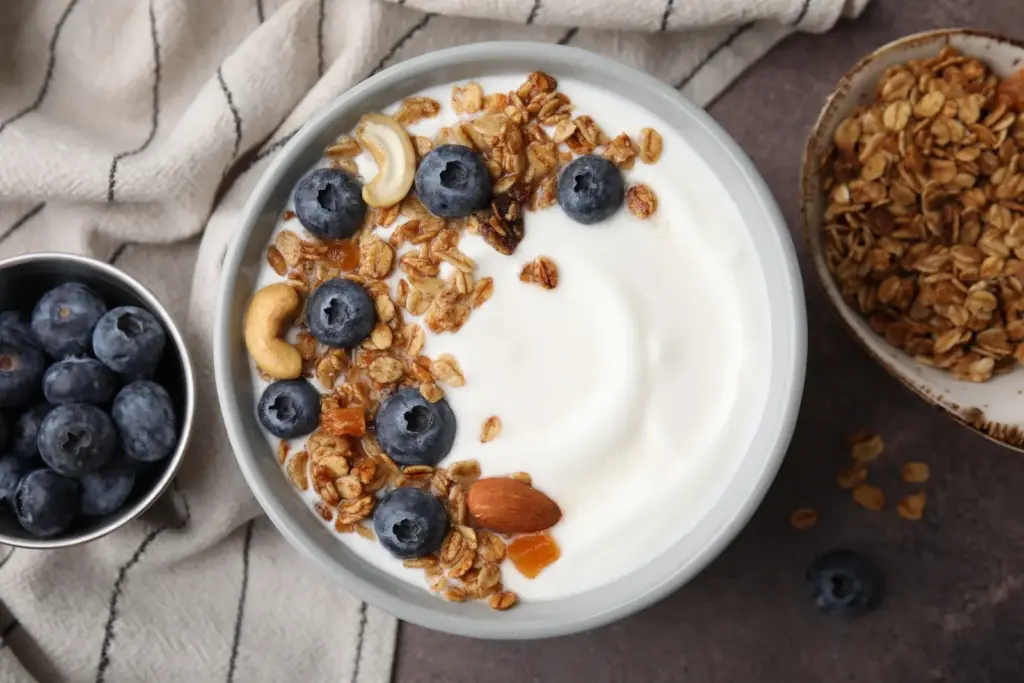
Greek yoghurt brings protein and calcium, the berries and seeds add fibre, and it takes five minutes. It is a good example of a breakfast that is balanced without being restrictive.
You will need:
- 200g tub Greek yoghurt
- 1 cup mixed berries
- 1 tbsp pumpkin seeds
- 1 tbsp almonds, chopped
- Drizzle of honey (optional)
What’s right for your PCOS?
PCOS looks different from person to person. What suits you depends on your symptoms, insulin and blood test results, your cycle, any medicines such as metformin, whether you are trying to conceive, and your relationship with food. Felicity looks at all of this in a consult and builds an approach that fits your life.
Felicity Bull is an Accredited Practising Dietitian. She sees clients in person in Mount Hutton (Newcastle and Lake Macquarie) and by telehealth across Australia. About PCOS nutrition support.
Book with Felicity →Common questions
What is the best diet for PCOS?
The 2023 International PCOS Guideline found no evidence that any one diet is better than another. It recommends healthy eating in line with population guidelines, tailored to the person, and warns against overly restrictive diets.
Should I eat breakfast if I have PCOS?
Jean Hailes recommends eating regularly to help stabilise insulin. One small trial in lean women found a larger breakfast and smaller dinner improved insulin and hormone markers, but it has not been widely repeated.
Do I need to cut out carbs for PCOS?
No. The guideline does not support any one diet composition. Choosing fibre-rich carbohydrates like oats, wholegrains and fruit, alongside protein, is a balanced approach.
Is PCOS now called PMOS?
Yes. A global consensus process led by Australian researchers renamed polycystic ovary syndrome to polyendocrine metabolic ovarian syndrome (PMOS) in 2026. It is the same condition.
Can a dietitian help with PCOS?
Yes. An Accredited Practising Dietitian can tailor eating to your symptoms, blood results, medicines and goals, which is what the guideline recommends.
Where this comes from
General information only, not personal advice. It does not replace advice from your doctor or dietitian.
- Teede HJ, Tay CT, Laven JJE, Dokras A, Moran LJ, et al. Recommendations from the 2023 International Evidence-based Guideline for the Assessment and Management of Polycystic Ovary Syndrome. Journal of Clinical Endocrinology and Metabolism. 2023;108(10):2447-2469. pmc.ncbi.nlm.nih.gov/articles/PMC10505534/
- Jean Hailes for Women’s Health. PMOS (formerly PCOS): symptoms, diagnosis and treatment. www.jeanhailes.org.au/health-a-z/pcos
- Jean Hailes for Women’s Health. Living with PMOS (formerly PCOS), updated May 2026. www.jeanhailes.org.au/health-topics/pmos/living-with-pcos/
- Jakubowicz D, Barnea M, Wainstein J, Froy O. Effects of caloric intake timing on insulin resistance and hyperandrogenism in lean women with polycystic ovary syndrome. Clinical Science. 2013;125(9):423-432. pubmed.ncbi.nlm.nih.gov/23688334/
- Shang Y, Zhou H, Hu M, Feng H. Effect of diet on insulin resistance in polycystic ovary syndrome. Journal of Clinical Endocrinology and Metabolism. 2020;105(10):dgaa425. pubmed.ncbi.nlm.nih.gov/32621748/
- Lim SS, Hutchison SK, Van Ryswyk E, et al. Lifestyle changes in women with polycystic ovary syndrome. Cochrane Database of Systematic Reviews. 2019;3:CD007506. pmc.ncbi.nlm.nih.gov/articles/PMC6438659/