
If you have been prescribed a GLP-1 medication, you may have heard that some of the weight you lose can be muscle rather than fat. It is a fair thing to ask about. Muscle keeps you strong, steady on your feet and able to do everyday things with ease, so looking after it matters as much as the number on the scales. This guide explains what the research shows, why protein tends to slip when your appetite is small, what strength activity can do, and where a dietitian helps. It is written for people already on treatment, alongside their prescriber.
At a glance
- Some of the weight lost on these medicines can be muscle as well as fat. A 2025 review of the evidence reported that trial participants lost 10% or more of their muscle mass over about 70 weeks of treatment.
- Muscle supports strength, mobility and balance, which is why Dietitians Australia and Exercise & Sports Science Australia raise frailty and falls as risks.
- Enough protein spread through the day, and regular strength activity, are the two steps most often recommended.
- The evidence that these steps fully protect muscle on treatment is mixed, but they are low-risk and widely recommended.
- A small appetite makes protein the first thing to slip, so it helps to plan for it.
Why muscle matters
Muscle is more than appearance. It is what lets you climb stairs, carry the shopping, get up from a chair and catch yourself when you trip. It also tends to shrink as we age, so losing extra muscle at the same time as losing weight is a particular concern for older adults.
Exercise & Sports Science Australia’s chief executive, Katie Lyndon, said in the September 2026 joint statement with Dietitians Australia: “Maintaining muscle mass plays a critical role in strength, mobility, and metabolic health.” The statement warns that substantial weight loss on these medicines can have unintended effects, including “nutrient deficiencies, lean tissue loss, function loss, and an increased risk of frailty and falls.” Those are the two professional bodies’ views as they argue for funded support (we explain the call in our post on the joint statement). They describe risks, not something that happens to everyone.
How much muscle can be lost?
There is no single answer, because studies measure it differently and people differ. A 2025 review of the evidence reported that participants in trials of these medicines lost 10% or more of their muscle mass over 68 to 72 weeks, which the authors compared with roughly 20 years of age-related muscle loss. Estimates vary between studies, so treat the figure as a guide to the size of the concern rather than a prediction for you.
Some loss of muscle can happen with any rapid weight reduction, so this is not unique to these medicines. What makes it worth planning for is how quickly appetite can drop, and how many people end up eating much less protein than before.
Muscle matters again if treatment stops. Australian Prescriber notes that weight that is regained may come back proportionally more as fat than as muscle, and recommends that people are supported to build and maintain muscle both while on treatment and after stopping. Our guide to stopping GLP-1 medication covers that stage.
Protein: the first thing to slip
When your appetite is small, protein foods are often the ones left behind. They are filling, and meat or eggs can be off-putting when you feel nauseated. A 2025 review of studies on these medicines reported that protein intake is frequently inadequate, and another review recommends that it is monitored. Dietitians Australia and ESSA make the same point in their joint statement: eating less makes it “harder to get enough protein, vitamins and minerals”.
A few habits help without turning every meal into a project:
- Start with the protein food on your plate, then add the rest if you still have room.
- Include a protein food each time you eat, snacks included, rather than saving it for one big meal.
- Choose softer, moister or cooler options when nausea or cooking smells put you off.
- Keep easy options on hand for low-appetite days, so you are not relying on the energy to cook.
| If you are… | Easy protein ideas |
|---|---|
| Barely hungry | Greek yoghurt, a boiled egg, cheese and crackers, a small glass of milk |
| Feeling nauseated | Cold or room-temperature foods such as yoghurt, cottage cheese, hummus or flaked tinned fish |
| Short on time | Tinned tuna or salmon, eggs, baked beans on toast, a milk-based smoothie |
| Not keen on meat | Eggs, dairy foods, tofu, tempeh, lentils, beans and chickpeas |
How much protein is right for you depends on your age, health, kidney function, activity and what you are eating now, which is why general targets can mislead. If you have kidney disease, check with your doctor before changing how much protein you eat. Our guide to what to eat on GLP-1 medication has more on eating well when you are barely hungry.
Working out where your protein is slipping, and how to fit it in with the foods you will actually eat, is something we do in a consult. About the GLP-1 consult →
Strength activity: the other half
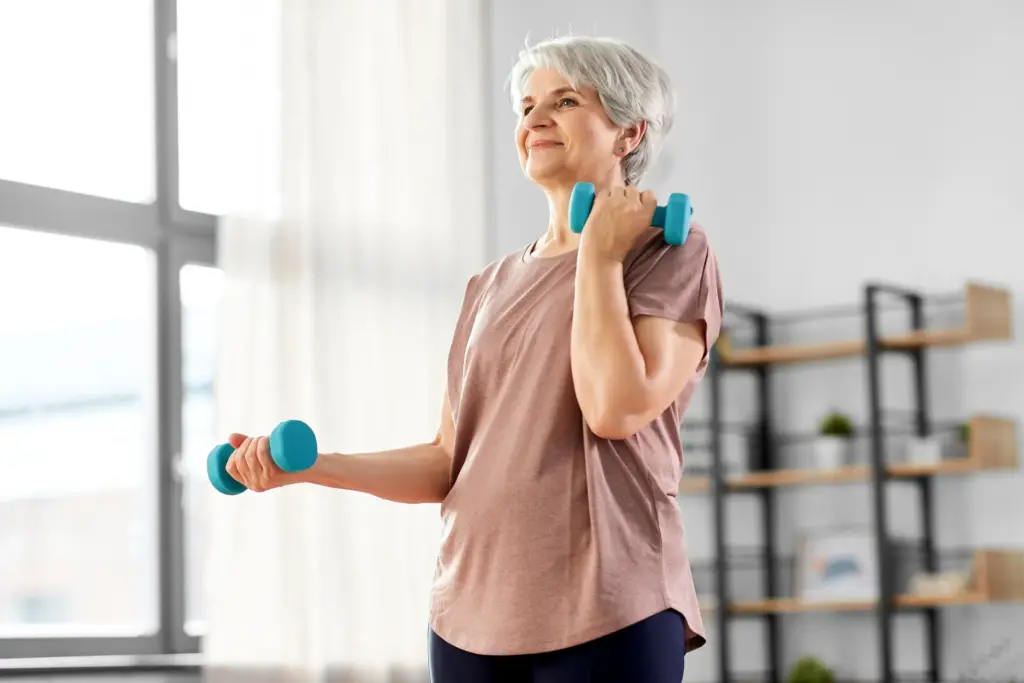
Reviews recommend resistance (strength) activity as a key way to limit muscle loss during weight reduction. A 2025 review states that it “has been shown to effectively minimize loss of muscle mass and function”. Another review notes that the evidence for it alongside these medicines specifically is mixed, so it is best seen as strongly recommended rather than a promise.
Strength activity does not need a gym. Options include:
- Bodyweight moves such as sit-to-stands from a chair, wall push-ups, step-ups and squats to a chair.
- Resistance bands, light weights or household items such as full water bottles.
- Daily-life strength: carrying the shopping, taking the stairs, gardening.
Build up gradually, and a few sessions a week is a reasonable place to start. If you have joint, heart or balance concerns, or have not exercised for a while, check with your GP first. An Accredited Exercise Physiologist can design a program around your health, and ESSA has a directory of accredited practitioners. If you feel dizzy or faint, stop, sit down and drink some water, and mention it to your doctor.
Keeping it balanced
For some people a focus on protein and exercise can tip into rigid rules or compulsive exercise. If food and movement start to feel like a source of anxiety, or you notice you are eating less to “earn” something or exercising to compensate, please talk to someone. Ausclin also offers eating disorder support, and we will talk it through gently and without judgement.
When to talk to your doctor
Tell your doctor if you notice new weakness, trouble standing up from a chair or climbing stairs, a fall or near-fall, or unusual tiredness. Do not change or stop your medication without talking to your prescriber. Seek medical advice promptly if you cannot keep fluids down or have ongoing vomiting with dizziness, and get urgent care for severe stomach pain that does not go away, especially if it spreads to your back.
Where a dietitian helps
A dietitian can look at what you eat on a typical day, find where protein is slipping and suggest ways to fit it in that suit your appetite, your side effects and your routine. We can also work alongside your GP or an exercise physiologist.
Our GLP-1 medication support consult runs for 45 minutes, by telehealth or in person at Mount Hutton.
About the GLP-1 consult →Common questions
Will I lose muscle on a GLP-1 medication?
Some loss of muscle can happen with any rapid weight reduction, and a 2025 review of trial data reported that it can be meaningful. Enough protein and regular strength activity are the steps most often recommended to limit it. Talk to your prescriber about your own situation.
How much protein do I need?
It depends on your age, health, kidney function, activity and what you are eating now, so general targets can mislead. A dietitian can work it out with you in foods you will actually eat. If you have kidney disease, check with your doctor before changing how much protein you eat.
Do I need protein shakes?
Food is the usual starting point. A review of strategies to limit muscle loss notes that getting enough protein and micronutrients may sometimes require oral nutritional supplements. A dietitian can advise whether one suits you and which to choose.
What exercise is best for protecting muscle?
Resistance (strength) activity, such as bodyweight moves, bands or light weights, is the type most often recommended. Start gently, build up gradually and check with your GP if you have joint, heart or balance concerns.
Is muscle loss a bigger concern as I get older?
It can be. Muscle naturally declines with age, and reviews note that older adults are at particular risk of losing too much. Dietitians Australia and ESSA also highlight frailty and falls as risks. That is a good reason to talk to your doctor and a dietitian early.
How do I know if I am eating enough protein?
It is hard to judge by feel, especially when your appetite is small. A dietitian can review a few days of your eating and show you where the gaps are.
Where this comes from
General information only, not personal advice. Talk to your doctor or prescriber about your own treatment.
- Mechanick JI, Butsch WS, Christensen SM, et al. Strategies for minimizing muscle loss during use of incretin-mimetic drugs for treatment of obesity. Obesity Reviews. 2025;26(1):e13841. doi.org/10.1111/obr.13841
- Yates N, South T-L. Injectable drugs for weight management. Australian Prescriber. 2025;48(6):197-202. doi.org/10.18773/austprescr.2025.052
- Chavez AM, Carrasco Barria R, León-Sanz M. Nutrition support whilst on glucagon-like peptide-1 based therapy. Is it necessary? Current Opinion in Clinical Nutrition and Metabolic Care. 2025;28(4):351-357. doi.org/10.1097/mco.0000000000001130
- Sibal R, Balamurugan G, Langley J, Graham Y, Mahawar K. Macronutrient, micronutrient supplementation and monitoring for patients on GLP-1 agonists: can we learn from metabolic and bariatric surgery? Nutrients. 2025;17(23):3659. doi.org/10.3390/nu17233659
- Dietitians Australia, Exercise & Sports Science Australia. Joint statement: multidisciplinary models of care for GLP-1 medications. September 2026. dietitiansaustralia.org.au/about-us/media-centre/joint-statement-multidisciplinary-models-care-glp-1-medications
- Sievenpiper JL, Ard J, Blüher M, et al. Nutritional and lifestyle supportive care recommendations for management of obesity with GLP-1-based therapies. Obesity Pillars. 2026;17:100228. doi.org/10.1016/j.obpill.2025.100228